Dohnuts-0.1.0-0.8B
A multimodal decision model built on Qwen3.5-0.8B. It scores supplied candidates from text and images, returning candidate probabilities, truth estimates, or ordered scores. Independent questions about one input share computation in a single forward pass. The interface returns decisions without generating reasoning or free-form answers.
Model details
Property |
Value |
|---|---|
Base model |
Qwen/Qwen3.5-0.8B |
Training |
Joint RLCD and auxiliary cross-entropy; language LoRA and a candidate scorer |
Selection |
Seed 42, update 3,600; highest development macro accuracy |
Calibration |
One temperature per decision type, fitted on an independent partition |
Runtime |
Merged LoRA, BF16, fused operations, shared input prefixes |
Inputs |
Text and one decoded image; 2–128 candidates per question |
Context |
4,096 tokens per question at inference; 2,048 during training |
Hardware used |
One AMD Radeon RX 7900 XTX, 24 GB |
Use
Dohnuts is intended for tasks with explicit candidate answers: routing requests, classifying content, estimating whether a condition holds, rating relevance, or answering visual questions. An application supplies the choices and decides how to act on the returned probabilities.
After setting up the runtime, load the model from Hugging Face:
from dohnuts.predictor import Predictor

model = Predictor.from_checkpoint("PsiACE/Dohnuts-0.1.0-0.8B")
The compact checkpoint contains LoRA and scorer weights. The loader downloads and caches it with the pinned base model, merges LoRA, and applies calibration. Weights are not bundled with the Python package. See the inference guide for question definitions, images, and response fields, or Bub integration for agent use.
Evaluation
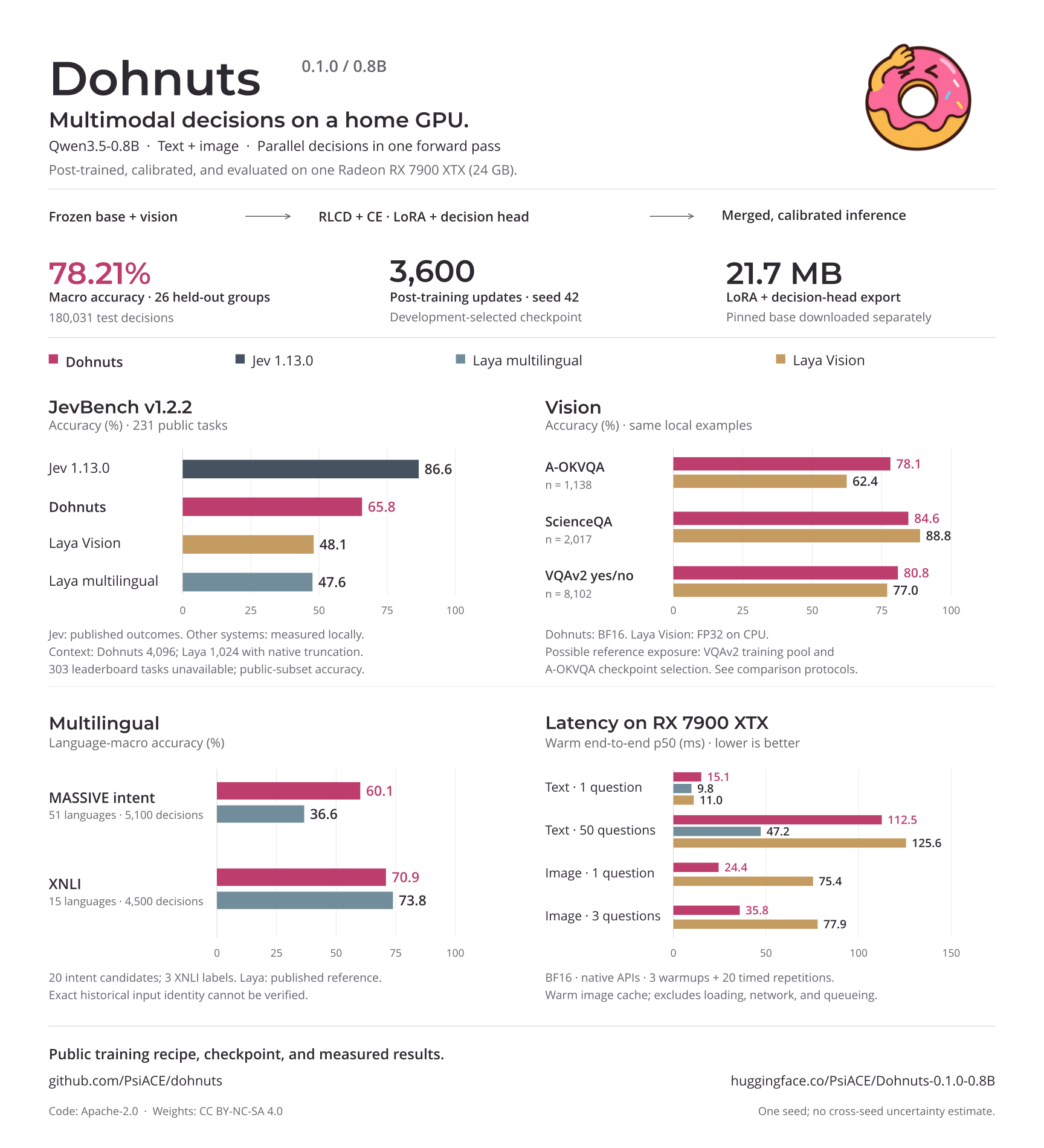
The model achieves 78.21% macro accuracy over 26 held-out dataset groups containing 180,031 decisions. Each group contributes equally to this mean. Development data selects weights; calibration data fits temperatures; test data does neither. This is one training seed, with no estimate of variation across seeds.
JevBench
Accuracy on the same 231 public tasks from JevBench v1.2.2:
Model |
Correct |
Accuracy |
|---|---|---|
Dohnuts-0.1.0-0.8B |
152 / 231 |
65.80% |
Jev 1.13.0 |
200 / 231 |
86.58% |
Laya multilingual |
110 / 231 |
47.62% |
Laya Vision |
111 / 231 |
48.05% |
Jev results use published per-task outcomes; Dohnuts and the two Laya checkpoints were measured locally. Dohnuts uses a 4,096-token limit; the Laya runs use their native 1,024-token limit and truncation. The other 303 leaderboard tasks are unavailable, including the judge tier. These accuracies are not the official four-axis leaderboard score.
Laya task suites
Dohnuts leads the published Laya multilingual reference on the 51-language MASSIVE intent suite, at 60.14% versus 36.61% language macro accuracy. Laya multilingual leads on the 15-language XNLI suite, at 73.84% versus 70.91%. The upstream question builders are preserved, but the historical reference’s input hashes are unavailable, so exact input identity cannot be verified.
Against Laya Vision on the same local image examples, Dohnuts scores higher on A-OKVQA and VQAv2 yes/no; Laya Vision scores higher on ScienceQA and has lower calibration error on ScienceQA and VQAv2. These runs use different precision and have reference data-exposure limitations, documented in the comparison protocols.
The comparison gallery includes every application suite, language results, vision accuracy and calibration, and paired JevBench outcomes.
Inference speed
Warm end-to-end median latency on one RX 7900 XTX, using BF16 and each model’s native API:
Workload |
Dohnuts |
Laya multilingual |
Laya Vision |
|---|---|---|---|
Text, 1 question |
15.07 ms |
9.77 ms |
11.00 ms |
Text, 50 questions |
112.51 ms |
47.19 ms |
125.63 ms |
Image, 1 question |
24.43 ms |
— |
75.41 ms |
Image, 3 questions |
35.84 ms |
— |
77.89 ms |
Measurements use three warmups and 20 synchronized repetitions, including preprocessing and transfers. They exclude model loading, network, and queueing. Image timings use warm caches. They do not measure uncached image encoding or service throughput under load. See the full charts and benchmark protocol.
Training
The mixture covers 26 text, language, and vision task groups, including public classification, question-answering, retrieval, policy, mail, and visual datasets. A fixed cap provides 143,238 eligible training rows; sampling is uniform over groups with replacement. The 3,600 updates process 115,200 sampled examples. Related documents and identical images are grouped to prevent cross-split leakage. Dataset sources, exclusions, and terms are listed in the data reference.
The base model and vision encoder are frozen. Training updates rank-8 language LoRA adapters and a shared candidate scorer. The joint RLCD and cross-entropy objective follows the pinned Laya and Laya Vision implementations. Its four samples perturb decision logits; they are not generated trajectories. LoRA is merged before temperature fitting and final evaluation. The RLCD specification gives the objective and fixed schedule.
Training datasets
The 26 training groups are derived from the following source datasets. Hub links identify the datasets; the download manifests pin the files, revisions, and checksums actually used, including official archives downloaded outside the Hub.
Task family |
Sources |
|---|---|
Intent and topic classification |
MASSIVE 1.1 (en-US, zh-CN), AG News, BANKING77 |
Entailment, emotion, and Boolean QA |
|
Visual decisions |
CLEVR 1.0, A-OKVQA, ScienceQA (image subset), VQAv2 (yes/no) |
Screen region decisions |
|
Typed decisions |
LocalLLaMA/typed-decisions, using public soft teacher distributions |
Retrieval and relevance |
Amazon ESCI (en, es, ja), WikiQA |
Policy and contract decisions |
|
Spam and phishing |
SpamAssassin, Nazario phishing corpus, UCI SMS Spam Collection |
JevBench tasks and the frozen Laya benchmark inputs are evaluation-only. The data protocol describes source-specific conversions, grouped partitions, exclusions, and terms.
Limitations
Quality depends on the task. Jev leads on the public JevBench tasks; Laya multilingual leads on several application suites and small text-batch latency.
Global temperatures do not improve every dataset’s calibration. The API’s
confidencefield summarizes a distribution; it is not a measured probability of correctness. Check calibration on the intended workload.Candidate wording, order, and input length can affect decisions. Over-budget inputs are rejected. A long-document result covers only the eligible subset.
Laya Vision has possible VQAv2 training-pool exposure and A-OKVQA selection exposure. Backbone pretraining exposure is unverified. These comparisons do not establish performance on unseen data for every reference.
Bub acceptance exercises the decision tool. It does not measure autonomous planning quality.
Artifact and provenance
Base revision: 2fc06364715b967f1860aea9cf38778875588b17.
Selected weight SHA-256:
196be33a0282537bcd821e2115643b352d0ad2a0bbaf7b242a1b7fe5bd96cfdf.
The exported checkpoint records calibration, selection, and partition hashes in
dohnuts.json. The results include loss, development accuracy,
held-out quality, calibration bins, latency samples, and resource measurements.
Their manifest identifies the selected weights and checksums each published table.
No training Git revision was recorded. Chart values
and a figure manifest accompany the comparisons.
License
The code is licensed under Apache-2.0. The decision weights are provided under CC BY-NC-SA 4.0 for non-commercial research. This grant covers the Dohnuts LoRA and decision-head contributions; the base model and source data retain their own terms.
The Qwen3.5-0.8B base is Apache-2.0. ScienceQA’s dataset terms include non-commercial and share-alike restrictions; other sources have their own research-use terms. The checkpoint is not offered as a commercially cleared model. See the data reference and attributions.